ARPGScaling Dexterous Manipulation
via Action Representation Pretraining
Dexterity, in motion.
Three tasks. Coordinated hands. Watch ARPG in the real world.
Each method is evaluated over 30 trials per task on the physical robot.
| Task | ARPG | π0.5 |
|---|
ARPG improves success on all three evaluated tasks, with the largest gain on pouring coffee beans: 33.3 percentage points.
Change the space.
Change the learning problem.
The same actions can be easier to model in a learned representation. Watch the data change coordinates before the generator learns their structure.
Raw action space
Learned action space
How this relates to ARPG
A decoder converts generated representations into robot actions.
Conceptual animation, not a projection of measured embeddings or a training simulation. A useful representation need not be lower-dimensional or flat. Its benefit depends on the pretraining objective, motion information retained, and decoder quality; the ablation does not establish manifold flattening as the cause.
Read the abstract
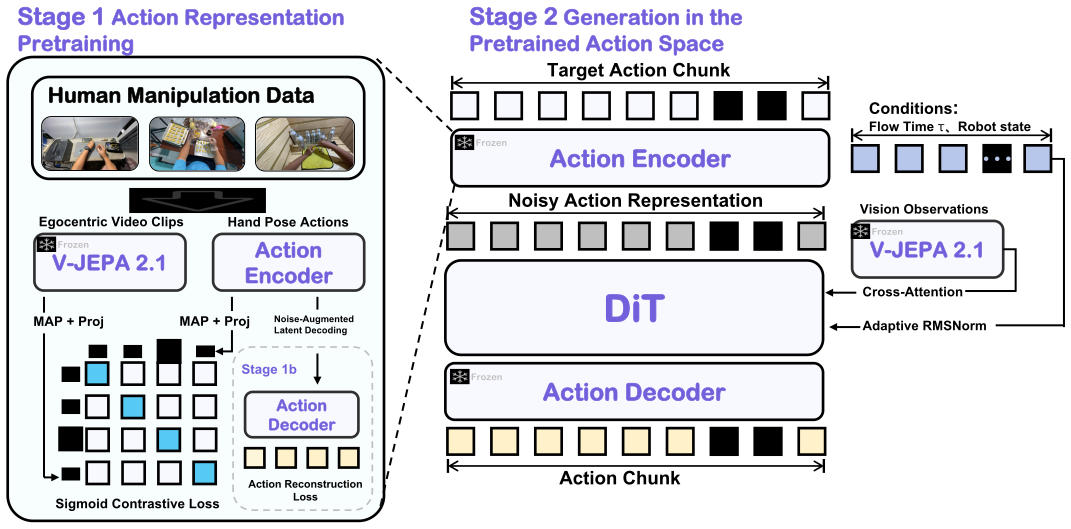
Learn the action representation space.
Then learn to generate representations.
Stronger dexterous manipulation.
Evaluated on DexJoCo.
Bimanual success rises from 10.1% to 44.7% under multi-task training. This is the clearest gain in the benchmark: coordinating two hands across multiple tasks.
Lower deployment costs.
π0.5: 9.05 GB
π0.5: 84.9 ms
π0.5: 3.35B · Backbone: 130M
Explore the full comparison · Table 1
| Setting | Method | Params (B) | VRAM (GB) | Latency (ms) | Single-arm (%) | Bimanual (%) | Overall (%) |
|---|
Source: Table 1. Baseline benchmark results are reported by DexJoCo. Inference costs follow the measurement configuration in the paper; they are not hardware-independent guarantees.
More diverse human actions.
Better action generation.
Can a better pretrained action space improve manipulation without more robot demonstrations or a larger generative backbone? We vary three pretraining dimensions separately.
The action space matters.
With robot demonstrations, observations, and the downstream generator fixed, visual alignment produces the strongest representation for generation among the evaluated objectives.
Action representation
Table 2(a) · DexJoCo overall success (%)
Additional ablations
Multi-layer aggregation
| Final encoder layers | Success (%) |
|---|---|
| 1 | 52.5 |
| 2 | 57.8 |
| 3 | 51.6 |
Auxiliary generation objectives
| Objective | Success (%) |
|---|---|
| Without REPA alignment | 54.85 |
| Without action decoding loss | 56.0 |
| Full objective | 57.8 |